


Drug Users Remembrance Day 2016

Updated: Aug 15, 2025
July 21, 2016
Last week, many people across the world observed Drug Users Remembrance Day--a day to remember those who have lost their lives due to substance use challenges and the failed war on drugs. This issue is very close to us at the shelter. Not only do many of our guests live with persistent substance use challenges (60%), but the majority of our staff have lived experience with this as well. Due to the criminalizing nature, stigma, and shame-based rhetoric associated with the culture of the war on drugs, people continue to die at alarming rates every single day in our country. A famous Canadian doctor and addictions specialist, Gabor Mate, often talks about the ways in which we talk about drug use in North America and how, as a society, we perpetuate dangerous drug use and make the problem worse.
"What the choice and heredity hypotheses share in common is that they take society off the hook. Neither compels us to consider how a person’s experience and social position contribute to a predisposition for addiction.
If oppressed or marginalized populations suffer a disproportionate share of addiction’s burden—as they do, here and elsewhere—it must be due to their faulty decision-making or to their flawed genes. The heredity and choice-based models also spare us, conveniently, from looking at how our social environment supports, or does not support, the parents of young children, and at how social attitudes and policies burden, stress, and exclude certain segments of the population and thereby increase their propensity for addiction."
--Gabor Mate--
Our shelter screens people in based on the complexity of the challenges that they face. These complexities have been studied among people experiencing chronic homelessness and have been found to put people at higher risk for dying if they are left out on the streets and disconnected from services. Most frequently, these complexities look like a combination of chronic illness, permanent physical disability, and living with mental health and substance use challenges. Many of our guests have been consistently screened out of services because of their drug use. This further marginalizes them and puts them at much higher risk for contracting deadly diseases and overdose.
We come from a perspective that people make decisions within the context of their environment. At the IW EOS we always aim to “zoom out” to find the context for someone’s behavior rather than blaming the individual for their behavior. Every one of our guests has experienced trauma/is currently experiencing systemic trauma that has a dramatic effect on their daily lives. It is our job (and, further, we believe, the job of our community) to recognize what trauma does to people and support them appropriately with that knowledge. What we know is that trauma often leads to substance use and dependency.
"Let us not be vague: people who use drugs are being killed. People have continued to die as a result of the drugs they use being of unknown purity and content due to their black market production – which demonstrably and directly results from prohibition. Opposition to harm reduction interventions has continued to drive catastrophically high incidence and prevalence of blood-borne infections like HIV and hepatitis C. And the cost of treatment for hepatitis C – the most important infection affecting people who inject drugs – has resulted in people continuing to die utterly needlessly from an entirely curable disease. Compounding this, the lack of access to antiretroviral drugs for people living with HIV has similarly resulted in ongoing and preventable morbidity and mortality."
--INPUD--
According to the Substance Abuse and Mental Health Services Administration, 39% (7.9 million people) of people living with substance use disorders are also living with mental health disorders. So often, when doing community education about the issues our guests face, I hear people talk with deep compassion for people with mental health challenges and have a strong understanding that those challenges are not someone's fault. Yet, conversations around substance use are often met with resistance and reactions that paint people who use drugs as selfish, untrustworthy, dangerous criminals. Here's the thing, though--SO many people from all possible backgrounds use licit and illicit drugs daily. In 2014, 20.2 million people were recorded to have a substance use disorder diagnosis! That doesn't take into consideration the millions of others without a diagnosis that casually use drugs--a nightly glass of wine to reduce stress, legal marijuana, prescription drugs, caffeine, sugar, etc., etc., etc.
Issues are never as simple (right/wrong, good/bad) as society wants us to believe. Part of our mission is to fight against the many iterations of stigma that our guests are up against every day. They have survived insurmountable odds, and I am honored that they chose to allow us into their lives. By providing an open and trusting environment for people who use drugs, we have been able to form relationships with our guests that allow us to have real conversations with them about their use and encourage ways for them to stay safer, be proud of who they are, and feel worthy of receiving love.
Practically, we have policies that support the drug users at our shelter, including an opiate overdose and administration policy. Based on the Good Samaritan Law, this policy allows for us to administer Naloxone, an opiate overdose reversal drug, for people that are in the midst of a deadly overdose. We have successfully reversed two overdoses that would have otherwise resulted in death because our support staff are trained in this life saving intervention. One of the overdoses was a 19 year old that had just returned from a drug treatment program with no skills or education around the risk of overdose, (significantly higher when coming out of an institution such as inpatient treatment or jail) and how to effectively stay alive.
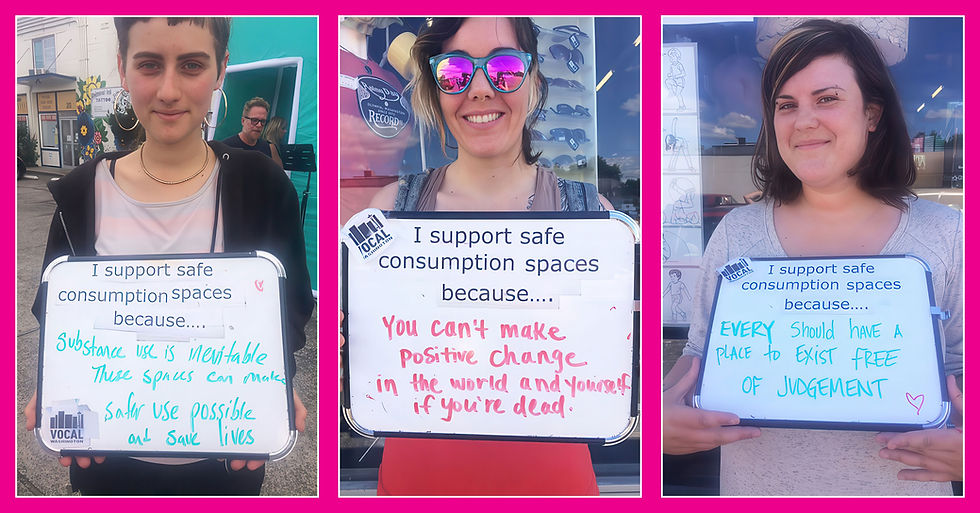
We also publicly support interventions that have been proven to save lives and decrease the negative effects of public drug use, such as Safe Consumption Facilities. According to the Washington chapter of VOCAL, "Supervised consumption facilities are controlled health care settings where people can more safely use pre-obtained drugs in a hygienic environment with access to sterile injecting equipment and under the supervision of trained care staff. Safe consumption spaces provide an array of support, including health care, counseling, and referrals to health and social services, including drug treatment." Recently, VOCAL brought an exhibit to Olympia to demonstrate what a room like this can look like. A number of our shelter staff swung by to check it out, and we were very impressed by the opportunity that something like this could provide for the overall safety and well-being of our entire community.
I certainly don't have all the answers, but what I do know is that "all life is sacred," as our shelter staff Jiva puts it in the photo. There is no positive change that can be made in the world or in ourselves if we stop breathing. Today, we honor the lives of those lost to
stigma, shame, condemnation, and fear. Your life matters, we see you and love you.


Comments